

Election2025

Today is election day which will determine who will have their hands on the city's controls. Will it be more of the same with many of the old council or will there be some new faces with new ideas?
In his latest post, Lorne Gunter expresses his opinion about the candidates who associate themselves with "Working Families", which by the way are many of the old council.

Edmonton Neighbourhoods United
2025 Candidate Report Cards
Hello friends,
We’re excited to announce that Edmonton Neighbourhoods United’s 2025 Candidate Report Cards are now available!
View the Report Cards on Our Website
These report cards reflect months of volunteer effort to help voters make sense of a complex election. They highlight where candidates stand on the issues at the heart of ENU’s mission — balanced growth, neighbourhood character, responsible planning, affordable housing, and meaningful public engagement.
Why We Did This
City Council’s decisions shape how our neighbourhoods grow, how infrastructure and amenities are prioritized, and how residents’ voices are heard.
ENU was founded by citizens from across Edmonton who believe growth should be thoughtful, transparent, and community-centred, not driven by blanket zoning or developer interests.
Our goal is to give voters clear, factual, non-partisan information before the October 20 election.
How the Scoring Worked
Each candidate was evaluated through a transparent process that considered:
- Survey responses to a detailed 30-minute questionnaire on planning, growth, and governance.
- Platform analysis of publicly available information.
- Voting records for incumbents, to reflect real-world decision-making.
Importantly, only one incumbent — Anne Stevenson — participated in the ENU survey. All incumbents were assessed using their voting records and public statements.
Explore the Full Results and Methodology
Independent and Non-Partisan
ENU is a volunteer-run, non-partisan organization. We do not endorse any candidates or political groups. These report cards are not endorsements. They’re a civic tool designed to inform and empower Edmontonians to make informed choices about the future of their city.
Thank you for caring about Edmonton’s neighbourhoods, and for supporting our shared vision of a city that grows wisely, listens carefully, and values its communities.
With appreciation,
The ENU Team

Campaign Roundup - Day 11
- Edmonton Elections is preparing contingency plans due to the Canada Post strike. Voter information cards may not be delivered, so residents can use online tools to find polling locations, ID requirements, and special ballot procedures. The City is offering 12 advanced voting stations, 222 regular stations, and options to pick up or return special ballots in person. Edmonton Elections is also boosting digital communications, including social media and digital billboards, to ensure voters have access to essential election information.
- Small business owners are urging mayoral candidates to address their concerns, particularly around crime, construction, and municipal spending. The Canadian Federation of Independent Business reports that over 70% of Alberta small business owners feel municipalities are not attentive to their needs, nearly 60% believe they don’t get fair value for property taxes, and 55% feel treated unfairly by local government.
- Four Edmonton mayoral candidates - Andrew Knack, Tim Cartmell, Michael Walters, and Rahim Jaffer - spoke at a forum on downtown challenges, arts and culture, and the City’s relationship with the Province. Candidates highlighted issues such as public safety, parking, and homelessness in the downtown core, with Cartmell emphasizing accessibility and safety, while Jaffer, Knack, and Walters focused on stable funding, reduced red tape, and greater inclusion for arts organizations. The forum also addressed tensions between the City and provincial government, with Knack and Walters calling for improved collaboration and action on housing and infrastructure, and Jaffer criticizing Edmonton for not leveraging its relationship with the province effectively.
- Mayoral candidate Rahim Jaffer pledged that, if elected, he will integrate 911 with 211 to ensure emergency and community resources are directed efficiently, which he believes will result in faster responses, reduced waste, and a safer, stronger city.

Campaign Roundup - Day 9
- Edmonton’s Mayor operates within Alberta’s “weak mayor” system, meaning they hold only one vote on Council despite having the highest salary and largest office budget. While the Mayor lacks legislative authority, they do have significant influence as the City’s publicly elected face and in representing Edmonton in national and international contexts. The introduction of political parties on the ballot could shift Council dynamics, but it remains uncertain how much party affiliation will affect decision-making once the council is in place.
- Mayoral candidate Tim Cartmell shared a message for National Day for Truth and Reconciliation, emphasizing honouring residential school Survivors, remembering those who never returned, and acknowledging ongoing intergenerational trauma. He noted that reconciliation is an active practice, calling for Indigenous-led health and cultural supports, genuine consultation, economic partnerships, and accountability through measurable progress. Mayoral candidates Michael Walters, Rahim Jaffer, and Andrew Knack also shared messages or attended events to honour the day.
- Michael Walters released a plan focused on strengthening Edmonton’s arts, culture, festivals, and non-profit sectors as key drivers of community well-being and economic growth. He proposes developing a Creative Economy Strategy, creating arts-friendly policies and incentives, supporting festivals and heritage celebrations year-round, and revitalizing main streets and the Arts District. Walters also plans to provide affordable spaces for cultural and community activities, and to build stable, long-term partnerships with non-profits through councils, roundtables, and sector summits.
- Rahim Jaffer has promised to establish a Recovery Village, where those struggling with homelessness, addiction, and mental illness can go to work on healing.

Below is a list of questions to ask candidates in regards to the upcoming election. The question drawn up by a number of concerned questions
- What is the job description of a councillor/Mayor?
- Does the power lie with the City Manager or City Council?
- Should citizens have a say or vote in the hiring of the City Manager?
- Do you think the City does a good job consulting with the citizens of Edmonton?
- Should engagement with groups (Province, Oilers Entertainment Group, Administration) take place before negotiations?
- Are initiatives like District Plans measured and are the public made aware?
- Do you think we all need to participate in making Edmonton a vibrant and safer city?
- Is it the City’s responsibility to help educate and encourage citizens to participate?
- Housing is Federal and Provincial jurisdiction. What role does the City play?
- Leadership – what values will guide your decisions?
- What is your vision for the future of Edmonton? How will you achieve your goals and measure outcomes?
- Do you find it easy to communicate with the city (eg. forms)?
- Why does it matter if it is a party or a single candidate?
- What kind of job is the City doing on climate change?
- Do you know about the Climate Energy Improvement Program (CEIP)? Do you think it is widely known?

At Edmonton Neighbourhoods United, our commitment is simple: to stand with residents and keep neighbourhood voices at the focus of our city's decisions. Recently, we raised concerns with the Provincial Government on your behalf regarding election fairness and transparency, because Edmontonians deserve transparency and honesty. Lorne Gunter at Edmonton Journal has also shed some light on these issues.
An undisclosed presentation has been discovered in which a group called Working Families Edmonton (WFE) may be acting as a behind-the-scenes campaign network - coordinating a slate of candidates (many seeking re-election), raising hundreds of thousands of dollars, and looking for ways around donation limits meant to keep elections fair.
What the behind-the-scenes strategy document shows:
· Fundraising goals as high as $749,000.
· Candidates presented as “independent” while sharing centralized resources, volunteers, and advertising.
· A candid line from the document itself: “This effectively is creating a party without being subject to the spending and donation limits.”
· Notes suggesting the same tactics were used in 2021, coinciding with some of the zoning bylaw and city district plan changes.
This kind of shadow coordination erodes trust. Our city works best when candidates are accountable to residents not to undisclosed donors with coordinated interests.
You can read more here:
· Blog & Context: Why Edmonton Needs Independent Leadership—Not Backroom Deals
· Lorne Gunter's Column: Lorne Gunter: Understand differences between civic election candidates | Edmonton Journal
What neighbours can do:
· Share this information locally.
· Bring it up at your community league.
· Ask candidates directly where they stand on transparency and third-party influence.
· Make your vote count. It’s time for a major shift at City Hall
Stay Tuned:
In the days ahead, ENU will be releasing the results of our Candidate Survey to provide clarity regarding October 20th's election candidate's platforms and opinions about the City's growth and issues. Sadly, some incumbents chose not to participate. Their silence leaves residents guessing about where they stand on infill and other key issues - making it harder to place our trust in their leadership.
Edmonton deserves leaders who earn our confidence by being open, accountable, and responsive to the people they represent.

Campaign Roundup - Day 7
- The Canada Post strike is affecting the 2025 Edmonton election, potentially delaying mail delivery. Voters applying for special ballots will receive their packages soon, and the City is working with alternative service providers. There will also be an option to pick them up.
- Edmontonians gathered at Herb Link Park to protest the current City Council, citing concerns over infill, bike lanes, crime, transit safety, and taxation. The protest, organized by Stop the Destruction of Dunluce in partnership with Better Edmonton, urged voters to replace current Council members with representatives who will listen to community voices. Several mayoral candidates, including Tim Cartmell, Rahim Jaffer, and Tony Caterina, attended to hear residents’ concerns.
- Mayoral candidate Tim Cartmell emphasized fiscal discipline and strategic growth for Edmonton, highlighting rising property taxes while infrastructure and the non-residential tax base have suffered. He proposed zero-based budgeting to make City Hall justify every dollar spent, alongside a “Build Now” tax deferral program to encourage business investment.
- At the MacEwan University Mayoral Forum, Andrew Knack highlighted the importance of supporting Edmonton’s youth. His plan includes tackling youth unemployment with jobs and placements, expanding recreation and mental health programs, creating opportunities for Indigenous youth to engage with culture, improving transit for students, and enhancing safety at transit centres.

Campaign Roundup - Day 6
- Transit is shaping up to be a defining issue in the Mayoral race, with candidates split on fares, safety, and future LRT expansion. Michael Walters proposes a four-year fare freeze, while Rahim Jaffer wants to revive the free-fare LRT zone downtown - both argue cheaper fares would boost ridership and safety through busier stations. Andrew Knack supports maintaining current fare levels and stresses that candidates must show how lower fares would be funded. On safety, Tim Cartmell pushes for turnstiles and dedicated LRT beat cops, Jaffer backs fare gates to deter crime, and Omar Mohammad promises more peace officers, AI-monitored cameras, better lighting, and nonprofit partnerships to address homelessness and addiction. Walters wants to open stations to more businesses, while Tony Caterina advocates selling “air rights” for development above stations.
- The Edmonton Journal is doing a series asking Mayoral candidates why they should be Mayor. Andrew Knack says he promises to put residents’ needs first in every decision. He highlights affordability, homelessness, housing, and safety as top priorities, while pledging responsible budgeting that maintains core services like transit, emergency response, and recreation. Knack pointed to his record of finding budget savings, proposes growing the City’s tax base through business development, and stresses transparency through full campaign donation disclosure and ongoing public engagement. He says rebuilding trust at City Hall is essential to addressing Edmonton’s growth and ensuring a stronger, more affordable city.
- In Ward papastew incumbent Michael Janz is seeking re-election but faces competition over issues like infill, zoning, and infrastructure. Janz emphasizes independence from developers, opposition to the downtown fan park deal, and his record on limiting infill density, while challengers argue Council has become too political and unresponsive. Better Edmonton’s Joshua Doyle highlights what he calls an “infrastructure crisis,” PACE’s Mark Hillman criticizes Janz for betraying neighbourhoods and pushing ideology, and Terrie Holgerson stresses better communication and community consultation.
- Ward Dene’s race centers on affordability, infrastructure, and public safety, with incumbent Aaron Paquette seeking a third term to complete projects like road upgrades and the $1.6-billion hydrogen energy complex at Aurum Energy Park. Paquette emphasizes growth management, job creation, and adding more peace officers and traffic enforcement. Challengers include Banisha Sandhu of Better Edmonton, who is calling for fiscal responsibility and teamwork; Albert Mazzocca, who is stressing lived experience, lower taxes, and provincial cooperation; Lana Palmer, who is highlighting economic resilience and affordable housing; and Paul Brake, who is campaigning on transparency and accountability.

Campaign Roundup - Day 1:
- While there’s no official “writ drop” in civic elections, today is nomination day. So, we’re calling this Day 1 of our Campaign Roundup.
- Nominations closed at noon today, but there may be some last-minute additions to the list that the City hasn’t processed yet. We’ll be sending out more information about the candidates soon. Voters will elect their Mayor, City Council, and School Board Trustees. If you aren’t certain which ward you live in, you can find out here.
- The municipal election takes place on Monday, October 20th. Advance voting will take place from October 7th to 11th. If you haven’t already registered to vote, you can still do so at the polling station. For a list of what you’ll need to bring with you to vote, you can visit the Edmonton Elections website.
- This is the first year that Edmontonians will see political parties on the ballot. There are two registered parties - Better Edmonton and PACE. There is also a slate (Yeg1st) and many independent candidates.
- Speaking of parties, Mayoral candidate Tim Cartmell announced that his Better Edmonton party will go dormant after the October 20th election, shelving its branding and infrastructure. He emphasized that this move is strictly for the election and will not affect Council operations.
- Edmonton Mayoral candidates are divided on whether City employees should return to downtown offices full-time or continue with hybrid work. Some, like Omar Mohammad and Rahim Jaffer, argue that a full return could boost productivity and help revitalize downtown, while others, including Andrew Knack, emphasize that hybrid work agreements and broader issues like safety, housing, and a nighttime economy are more important for downtown’s vibrancy.
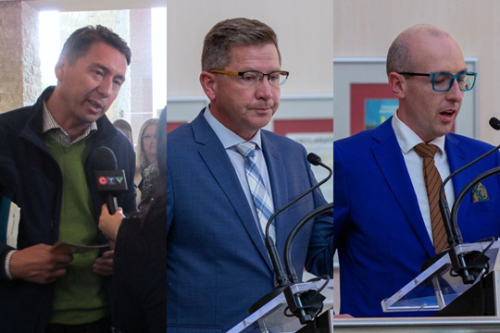
Few Albertans will approach the ballot box this October intending to elect a weak mayor, but that’s exactly what they will get. As part of Taproot’s ongoing election analysis and coverage, today we examine what’s known as the weak mayor system, where the mayors we’re set to elect in the Edmonton region will largely be equals among their council peers and therefore lack executive, or “strong” mayoral power to push policies through without first convincing at least half of the council to vote with them.
How does this affect elections, voter perceptions, and the results of those we elect? Taproot has endeavoured to ask those questions and find out.
The current weak mayor system
As Brian Kelcey, a former advisor to the mayor in Winnipeg, has argued, most Canadian cities are still governed under the “same weak-mayor model as a 19th century Upper Canada Village.” In a nutshell, this means that most mayors in Canada (and all in Alberta) are effectively just another councillor with an equal vote to the others, plus some additional duties, like chairing council meetings or serving as a figurehead at ceremonial events. Mayors are also, unofficially, the email address or name that residents often channel their blame towards when something isn’t to their liking in a city.
Why does this matter? When it comes to elections, Kelcey suggests the weak mayor system can create a “disconnect” between voters and the actual power of the mayors they elect. As he points out, mayors routinely receive more votes in a municipal election than all other councillors combined. That means any platform they may have run on to win those votes, like say, promising to build more transit or incentivize more housing, has a strong mandate from voters. But the weak mayor system requires them to work in the background to marshal at least half of the council to agree with them. And beyond this limitation, mayors in these systems are also often tasked with chairing meetings, often silently.
On the ground, Kelcey has argued, this means that mayors can be less prominent than you might expect in council debates. He points to Calgary for an example: In 2022, Mayor Jyoti Gondek voted no on a police request for an additional $6 million beyond an already-approved $9.6-million increase, having run and won more than 176,000 votes on an election platform that promised a “progressive police force”. A majority of councillors voted to give the police the money, with Gondek losing the vote 11 to 4. Kelcey noted that Gondek had not articulated her position because she was chairing the meeting; instead, her reasoning to vote no — that the police had not delivered on commitments to work on anti-racism, among other things — only came out in interviews after the vote.
Taproot looked at Edmonton Mayor Amarjeet Sohi’s voting record from 2021 to today and where, in particular, he was on the losing side of council votes. One trend is that many of the motions that Sohi has introduced during this council term have been procedural — to go in-camera, to meet in public — as would be expected from someone who is often the meeting chair, so he tended to win those. Nonetheless, Sohi did lose on several votes on issues that people care about. In 2023, for example, Sohi voted against amending bylaws to allow for mixed-use buildings with a focus on supportive housing in McCauley, but the majority of council disagreed; in 2022, Sohi voted no on a motion from Coun. Anne Stevenson about the police funding formula that council passed; in 2022, Sohi voted no on several motions from Coun. Tim Cartmell about snow and ice removal that council passed. This is far from an exhaustive list, and anyone wanting to dive deeper can examine the full list.
Jack Lucas, a political scientist at the University of Calgary who’s a leading researcher in Canada on municipal democracy and representation, told Taproot that voter disconnect can boil down to a general challenge for voters to understand what council did, and then further to understand who on council did that thing. “All it takes is a majority vote of council, including the mayor, for a bylaw to pass,” Lucas said.
What that means is there can often be no clear delineation or responsibility. “In the absence of parties, it’s hard to understand (who’s done a thing), because you don’t have a councillor who’s in the opposition or who’s in the majority, and the same is true of the mayor,” Lucas said. “So, if council does something, it may have been against the wishes of the mayor, but it takes some explaining on the part of the mayor or the mayoral candidate to make that clear. In provincial or federal politics, if the government did something, you know it was the government party responsible and you can hold them accountable, (and) reward or punish them accordingly.”
In a weak mayor system, Lucas continued, the lack of clarity leads to interesting votes once the next election comes around. “Sometimes, if people are unsatisfied with what their council has done, they will punish all of council or the mayor, even if it wasn’t necessarily all of council or the mayor who supported those things,” he said.
Voters put a lot of thought into their votes for mayor, said Jack Lucas, a political scientist at the University of Calgary who’s a leading researcher in Canada on municipal democracy and representation, but the weak mayor system can introduce layers of abstraction into what they can expect in return. (Mack Male/Flickr)
In Ontario, mayors are getting stronger
The weak mayor system is not set in stone, and a push to give mayors more power (as we see in most large cities in the U.S.) is gaining momentum in Canada. Some suggest more powerful mayors can more directly respect voter intentions. Others suggest stronger mayors can “cut red tape” or deliver on provincial priorities.
Housing in particular is the reason Ontario thinks its experiment with stronger mayors was worth it. In 2022, Ontario Premier Doug Ford’s government passed the Strong Mayor, Building Homes Act to allow mayors in Ottawa and Toronto to push through municipal policy changes that would enable housing development, stop changes that would limit it, hire or fire senior city staff, and propose budgets or stop adjustments to them. Since then, the province has expanded these powers to 167 other municipalities in Ontario.
The only way to limit the power of these stronger mayors in Ontario in these instances is for two-thirds of their council to vote against them. “Mayors know their municipalities best, and we support them in taking bold actions for their communities,” said Rob Flack, Ontario’s minister of municipal affairs and housing, in a release in April.
Still, Lucas stressed that Ontario’s changes are not a full strong mayor system. “The mayor still has one vote on council,” he said. “There are ways that the mayor can override council and so forth, but it’s not all the way to a strong mayor system like you have in the United States, where the mayor is the equivalent of the president, kind of, who runs the executive, while the council is the legislature.”
What are the benefits and tradeoffs? “I guess the argument for this (system) would be from the standpoint of democratic legitimacy,” Lucas said. “If people know a lot about the mayor, if they invest a lot of time and energy in voting for a mayor, they want that mayor to be able to enact their agenda that they were elected to enact, and that giving them the authority to do that without being overridden by some coalition of council that doesn’t have the same kind of cross-city mandate ... might make for effective representation.”
Lucas said he’s not sure that’s what’s happening in Ontario, however. “We have to wait and see still how well it’s working,” he said. He did note, however, that the strong mayor system has, in principle, advantages to clarity of responsibility and accountability, and that bot are desirable qualities, especially for bringing a mayor’s powers “into alignment with how ordinary people think about the mayor as having particular importance and a particularly important role in municipal councils.”
Party time?
Alberta’s provincial government, like all other provinces, has the constitutional authority over municipal governments here to create nearly any set of rules it sees fit. In 2024, the United Conservative Party government did just that. Though it avoided creating stronger mayors, it has started changing election rules. Thanks to Bill 20, the coming election will be the first to see Edmonton and Calgary permitted to bring parties into the municipal election.
Premier Danielle Smith has suggested the change simply codifies the partisan nature of municipal politics in larger cities. “We’ve got 355 municipalities. The smaller the municipality, I don’t know that they’re as partisan,” she said in February 2024. “But when you get into a city the size of Calgary or Edmonton, you better believe it’s partisan.”
Albertans said they preferred the electoral system without, however, with 68% of respondents to a survey commissioned by Alberta Municipalities suggesting people prefer candidates to run as individuals rather than as members of parties.
When it comes the mayoral election, Lucas expects the introduction of parties to be less decisive for the mayoral race than it will be for candidates running for council seats. “I think that municipal voters in Calgary and Edmonton always pay a lot of attention to their mayoral vote,” he said. “So, I would think about the effective party more in the world of council votes than mayor votes.”
Lucas said his time with candidates during elections has informed his thinking on this point. “One thing I noticed last (election), when I was going around with some candidates as they were door knocking, is you hear a lot of voters saying, ‘Well, which mayoral candidate do you support?’” he said. “And this is a perfectly sensible thing to ask, even in a nonpartisan system, because maybe you know a lot about the mayoral candidates. You don’t know anything about the council candidates, so you just ask a council candidate. That gives you pretty good information about if this candidate standing in front of you is someone that you would support or not.
“Now (with parties), we have a situation where a number of candidates are actually affiliated with a mayoral candidate as part of a party. So whereas in the past, the candidates were always quite hesitant to answer that question, now, at least (if) they’re in a party, they might be quite happy to say, ‘Well, the mayoral candidate I’m affiliated with is so and so, because we’re in the same party, and I support their vision, and they support my vision, and we’re going to work together to get things done on council.’”
If that candidate is not with a party, Lucas said, they may struggle to answer the question or worry the answer might not align with a potential voter, adding another layer of complexity to the election or a candidate’s ability to connect with a voter.
By Tim Querengesser, TAPROOT Edmonton